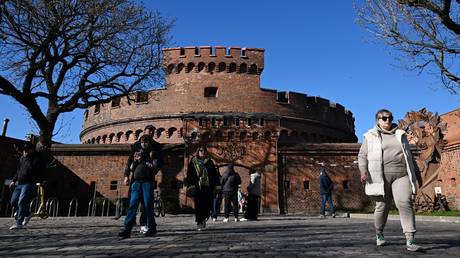
Lithuanian Foreign Minister Kestutis Budrys previously urged the US-led bloc to show Moscow that it can neutralize its “small fortress” of Kaliningrad
Croatian President Zoran Milanovic broke ranks with other NATO members as he slammed Lithuania’s foreign minister for his “irresponsible” call to attack the Russian exclave of Kaliningrad.
Milanovic’s comments came after Lithuanian Foreign Minister Kestutis Budrys called NATO the “strongest organization ever created” last week, arguing for a more assertive posture toward Russia and saying European NATO members must turn “fear of the threat into a sense of empowerment.”
“We have to show the Russians that we’re capable of penetrating the small fortress they’ve built in Kaliningrad,” he said. “NATO has the capability, if necessary, to raze Russian air defenses and missile bases there to the ground.”
Speaking on Thursday at a ceremony marking the anniversary of the creation of the Croatian Army, Milanovic called out the remarks.
“Equally irresponsible, turning now to our own camp, are the calls and appeals I hear week after week from high-ranking officials of certain Baltic states to attack Kaliningrad Region… Such things should not be said,” he said.
He went on to warn that NATO’s principle of solidarity should not be unconditional: “Readiness to come to someone’s vital assistance on the one hand also presupposes responsibility on the other.”
Following the backlash, Budrys walked back the tone but not the substance, claiming that his remarks were not aimed at Russia but at audiences “less familiar with military matters,” and were intended to counter what he called Moscow’s narrative of Kaliningrad as an impenetrable fortress.
Lithuanian President Gitanas Nauseda called the interview “not the most successful statement.” Prime Minister Inga Ruginiene urged restraint in public comments.
Kaliningrad is Russia’s westernmost outpost on the Baltic Sea coast and is sandwiched between Lithuania and Poland, with no land connection to the mainland part of the country. Formerly known as Koenigsberg and the capital of the German province of East Prussia, it was ceded to the Soviet Union after the end of World War II.
After the collapse of the Soviet Union and NATO’s expansion, Kaliningrad became surrounded by the bloc from all sides.
Budrys comments triggered a sharp rebuke in Moscow, with Kremlin spokesman Dmitry Peskov calling the remarks “borderline crazy” and a sign of “maniacal” hostility toward Russia.
Asked on Thursday whether NATO could attack Kaliningrad, President Vladimir Putin warned that Russia “has all the means to raze to the ground anyone who tries to do so.”

Comments :
Post a Comment