The Commission chief has used the Middle East escalation to question the global order and push for a more militarized security doctrine
European Commission President Ursula von der Leyen has failed to condemn the US-Israeli war on Iran, saying “there should be no tears shed for” Iran’s late Supreme Leader Ayatollah Ali Khamenei, who was killed in the initial strikes.
Speaking at an annual conference of EU ambassadors on Monday, von der Leyen brushed aside debate over whether the attack on Iran “is a war of choice or necessity,” portraying it instead as opening “a path towards a free Iran.”
“I believe this debate misses the point,” she said. “I want to be clear: there should be no tears shed for the Iranian regime. This regime has inflicted death and imposes repression on its own people.”
AB Komisyonu Başkanı Ursula von der Leyen:
''İran rejimi için gözyaşı dökülmemeli. Bu rejim kendi halkına ölüm getirdi ve baskı uyguladı. 17 bin genci katlettiler.
Bu rejim, vekil güçleri aracılığıyla bölgede yıkım ve istikrarsızlık yarattı.
The EU has faced criticism for failing to issue a unified statement for nearly 48 hours after the initial US-Israeli strikes on Iran. Public outrage centered on a post in which von der Leyen said she would convene an emergency security meeting on Iran two days later, prompting widespread mockery of what users described as the EU’s bureaucratic inertia and geopolitical incompetence. She has also drawn criticism for calling Iran’s retaliatory strikes on Israel and US bases “unjustified” while refraining from condemning the initial US-Israeli attacks.
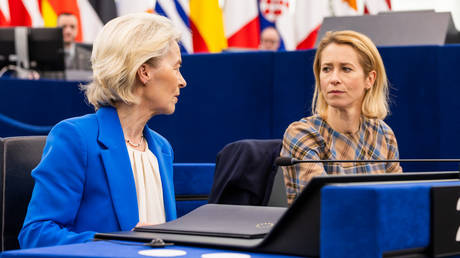
In recent days, critics have accused von der Leyen of diplomatic overreach after a flurry of posts about the Iran war – including signals of support for regime change in Tehran – and multiple calls with Gulf leaders. According to a Politico report on Monday, diplomats, EU officials, and lawmakers have criticized what they see as her attempt to position herself as the EU’s chief voice abroad despite lacking a mandate, amid what is widely believed to be a behind-the-scenes power struggle with the bloc’s top diplomat, Kaja Kallas.
In her speech on Monday, rather than focusing on the conflict itself, von der Leyen used the escalation to question the West’s so-called “rules-based” international order and argue for a shift in the EU’s security posture.
“The longer-term impact is already posing existential questions about the future of our international rules-based system,” she said, adding that “Europe can no longer be a custodian of the old world order.” She also questioned whether the bloc’s reliance on “consensus and compromise” in foreign policy “is more a help or a hindrance,” urging the EU to prepare “to project our power more assertively.”“In simple terms,” she added, this means higher investment in the military.
Russia has long argued that the West’s “rules-based order” is a tool of hegemony, allowing it to invent rules to suit its interests while bypassing formal institutions, and has instead called for strict adherence to international law as defined by the UN Charter and the UN Security Council. Russian officials have condemned US-Israeli strikes on Iran as a “direct violation” of international law.
Moscow has also criticized the EU’s ongoing militarization. European NATO members last year agreed to raise defense spending targets toward 5% of GDP and launched initiatives such as ReArm Europe to revamp their militaries. The push was initially framed as a response to an alleged Russian threat, a claim Moscow has repeatedly dismissed as “nonsense.”

Comments :
Post a Comment